Time Out, Time Off

February 23, 2023 | Filed Under Things I Think About | Comments Off on Time Out, Time Off

In one of the meditations in Simple Abundance, Sarah Ban Breathnach wrote: “I momentarily let go and allow the Universe to proceed without my assistance or supervision.”

This is difficult for me to do, and for most of the people I know. We feel as though we need to be “on” all the time, to be working on something productive, or, at the very least, to be doing something self-improving. The idea of doing something simply because it is pleasurable can be difficult to process.

As CEO of my own company, and the President of an education non-profit, I spend my work day making sure that things proceed in an orderly and business-like manner. It’s all about keeping the chaos flowing in a productive and constructive channel. The chaos can’t be eliminated, but it can be channeled (most of the time).

A close-up of a calendar page with the words Day Off written it.

My time away from the office is especially precious. The only thing I have to manage is myself (which, some days, is honestly more effort than running two companies), and I can focus my time and energy on the activities that are important to me—writing, research, doing divination, and various creative arts and crafts. I do a variety of fiber arts, and bead work, and I love drawing and painting. I will never win a prize with my art, but the joy I experience in the act of creation, and the peace it brings to my soul, are prizes far beyond any worldly recognition.

Also, napping. The hour or two of rest I find in a Sunday nap often feel as restorative as a full night’s sleep.

Queen Margrethe of Denmark, who, as you might imagine, has just a few obligations and responsibilities, takes every Sunday off to work on her art. Her Majesty spends those hours painting, creating textiles, making découpage works, creating scenography designs, and doing embroidery. She has created scenery and costumes for theatre and dance companies in Denmark. I was fortunate to see an exhibit of her work on a business trip to Copenhagen. Her imagination is vivid, and her talent is notable.

I remind myself that, if the Queen of Denmark can take a day off every week, *I* can take a day off every week. Granted, Her Majesty does not have to cook, or do laundry, or clean, and I do. I plan around that (Saturday night’s leftovers are Sunday’s meal), so I can keep my Sunday time mostly free of domestic work. I know that I am fortunate in this regard, and that not everyone can do this (having children and/or dependent elders imposes obligations that cannot be ignored for an entire day). I am not going to blithely offer useless suggestions for those situations; I simply offer my hope that, for people who do have such obligations, they are able to find some time for their own pleasures and passions, without the worry that the universe will come to a screeching halt when they do so.

Oracular Seidh Ritual for February 26, 2023 – In Person and on Zoom

February 22, 2023 | Filed Under Classes, Workshops, Conferences | Comments Off on Oracular Seidh Ritual for February 26, 2023 – In Person and on Zoom

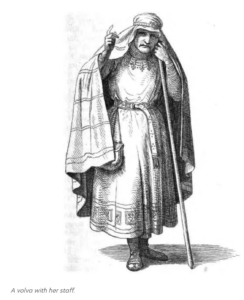
The Seidhjallr Team of Hrafnar Kindred presents a ritual of Oracular Seidh on Sunday, February 26, 2023.

Hrafnar is a Troth-associated Kindred.

Would you know more prior to attending? Check out “The Hrafnar Seidh Ritual” at
https://seidh.org/articles/seidh/

Disclosure: I am a member of the Seidhjallr Team, and will be the Cyber Warder for the event.

It will be a hybrid event:
*in person at the Berkeley Fellowship of Unitarian Universalists (BFUU) at 1924 Cedar Street, Berkeley, CA.
*via Zoom for those unable to attend in person.

Doors and the Zoom meeting will open at 5:00 PM PST for set up, and the pre-ritual information talk will begin at 5:15.

DM me for the Zoom link.

A donation of $5 is suggested, but is not required.

Bring your questions and our seeress will seek answers….

A black-and-white line drawing of a woman in medieval Norse clothing. Her right hand is raised, with her index finger pointing up. Her left hand holds her staff. The caption reads A volva with her staff.

Small Devotions: Fiber Arts and Bead Craft

February 21, 2023 | Filed Under Devotions, Things I Think About | Comments Off on Small Devotions: Fiber Arts and Bead Craft

One of my favorite ways to spend offline time is making things, and that’s often via one of the fiber arts: weaving, embroidery, or sewing. I also spend a fair amount of time doing bead work, for my own delight and to make gifts to others.

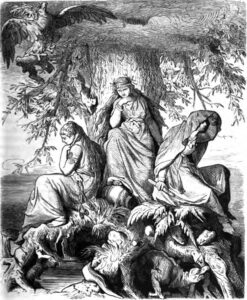
Despite the lack of evidence for the Nornir as the spinner, weaver, and wielder of scissors we think of these days (see my review of Karen Bek-Pedersen’s The Nornir in Old Norse Mythology for further information), that imagining of them works quite well for me. Thus, in my personal practice, I continue to see Urd as the spinner, Verdandi as the Weaver, and Skuld as She Who Wields the Scissors, and correspond them to Past, Present, and Future.

A black-and-white line drawing of the three Norns at the base of Yggdrasil.

The Norns by Ludwig Burger

Frigg is also revered as a Spinner and Weaver—some people believe she is the one who spins what the Nornir weave.

Thus, with my frame of reference, I call upon Frigg and the Nornir in my fiber work in a few different ways.

Once I have assembled my tools and supplies, I ask for their blessing on my work:

Hail, Urd, Spinner of That-Which-Has-Been!
Hail, Verdandi, Weaver of That-Which-Is-Becoming!
Hail, Skuld, You who wield The Scissors, Seer of That-Which-Is-Yet-to-Be!
Hail, Frigg, Allmother, Wise Woman, Spinner and Weaver Divine!
I ask your blessings on my work.
Guide my hands so that they move faithfully and true, for quality in my work.
Guide my eyes so that I see clearly and correctly, for accuracy in my work.
May my stitches/weaving/etc. be strong and durable,
So that my creation fulfills its purpose [add specifics if you like, e.g. “of keeping the wearer warm” or “helping me feel confident”]
And that my creation lasts as long as needed, and then some.

And then I set to work.

When it comes time to tie off a thread when I’m hand sewing, I make three triple knots. For the first two, I recite the following, each line being said as I make one loop of the knot:

With thanks to Frigg,
With thanks to Urd,
With thanks to Verdandi,
For your blessings on my work.

For the last knot, I recite one line per loop, and add the last sentence as I cut the thread:

With thanks to Frigg,
With thanks to Urd,
With thanks to Verdandi,
With thanks to Skuld <cut thread>
For your blessings on my work.

If I’m using my sewing machine, I recite the first piece as I do the overstitching, and the second piece when I cut the thread.

For bead work, I ask the blessing of Freya as well when I begin:

Hail, Freya, Vanadis!
Wearer of Brisingamen,
Divine Beauty,
Divine Love,
I ask your blessing on my work so that its beauty
Enhances the beauty of the one who wears it,
And brings beauty to all who behold it.

Each of these take just a few seconds to do, and add meaning to what would otherwise be just another activity. I find that they help me to focus on my work, so my work is better, and I am more able to take pride in the items I create—and more comfortable in doing so.

Book Review: “The Norns in Old Norse Mythology” by Karen Bek-Pedersen

February 19, 2023 | Filed Under Reviews | Comments Off on Book Review: “The Norns in Old Norse Mythology” by Karen Bek-Pedersen

The Norns in Old Norse Mythology by Karen Bek-Pedersen
Dunedin Academic Press Ltd, 2011
224 pages, including index and extensive bibliography

With impeccable timing, my copy of this book (ordered directly from the publisher) arrived a few weeks prior to the deadline for the Jotnar-themed issue of Idunna, the magazine of The Troth, where this review first appeared.
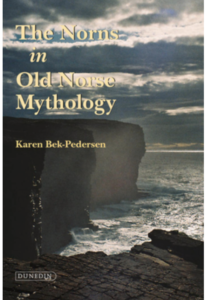
A photo of the book's cover, which shows the sea washing up to a sharp cliff. The book's title, the author's name, and the publisher's name are also on the cover.

The book is based on the author’s doctoral thesis. While expanded for a broader audience, it is still a chewy work, giving the reader much to consider, without being unreadable in its thoroughness. All references to other works are clearly and understandably noted, and the endnotes to each chapter add useful information without bogging down the main text.

She acknowledges what all of us who engage in research keep in mind as we do our work:

“It should not be imagined that Old Norse mythology, world view and traditions were ever static; culture is a continuous process, not a finished product.”
Page 3

Bek-Pedersen begins with a discussion of the difficulty of defining the Norns, in relation to, and distinct from, other powerful female figures—disir, valkyrur, fylgjur, and volur. While there is overlap between the Norns and each of the other figures, she finds sufficient material in the sources to establish the Norns as a unique type. This in particular stood out as I was reading:

Nornir rarely appear in person but it is common for volur to do so, and it seems fair to say that nornir are generally conceived of as distant, intangible beings who go about their tasks somewhere beyond human reach while volur, where these are described as physically present in human society, represent a more comprehensible version of similar otherworldly knowledge. Volur nevertheless always retain some otherworldly quality. In this way, volur and nornir may actually represent similar notions, only in different formats or on different levels.”
Page 60 – Page 61

The volva as a messenger from the Norns—does this sound like Oracular Seidhr, or what?

She then moves to a discussion of the names as we currently know them—Urd, Verdandi, and Skuld—and their domains of past, present, and future. Surprisingly, there is not a great deal of support in the the Lore for this particular set of names, nor for the past/present/future attributions, despite these being so common in modern practice. Her conclusion is that, while each region had its own myths and aspects for the spirits and deities, the similarity of these associations seems more like a later imposition, bringing in the qualities and associations with the Fates by those educated in classical Greek or Roman myths. That may be, but the names and temporal associations work quite well, so I’m going to continue with it in my practice.

The fourth chapter contains a discussion of the Norns and their associations with textile work. The chapter opens:

“The fact is that textile and textile work are in many ways good metaphors for how the concept of fate operates. But the fact is also that there are no clear-cut and unequivocal representations of the nornir engaged in spinning or weaving to be found anywhere in Old Norse literature. This could be due to accidental loss of parts of the tradition—the source material that survives is not necessarily representative of the tradition as a whole. On the other hand, we can only work with what we actually have and, in spite of the general tendency to discuss them, we do not have any spinning and weaving nornir.”
Page 123.

I’m sensing another incursion of Western Classical Education.

She continues:

“There are, however, three texts that come close and, although none of them constitutes firm evidence, they all merit some disussion here.”
Page 123

Perhaps there is hope!

She then analyzes the mentions in Volundarkviða, Beowulf, and Darraðarljóð. She notes that:

“Both ‘text’ and ‘textile’ derive from the Latin verb texere, ‘to weave’, and it is perhaps telling that, in terms of etymology, ‘text’ is a later development than ‘textile’; the woven textile came before the written text an weaving before writing. However, this also indicates that both can be forms of narrative.”
P. 150

However, she concludes:

“The fate-as-textile metaphor does exist in the Old Norse material, but not to an extent where one can be careless about referring to it, and, on the rare occasions where it is found, the nornir are usually not directly involved. . . .spinning or weaving nornir remain conspicuously absent from the sources, certainly in comparison to how much they figure in scholarship.”
P. 157

Once again, the Western Classical Education has imposed itself on thinking and practice. Harrumph.

On the other hand, the metaphor works quite well, even if it is a later imposition of another mythos, and that’s why we continue to make these associations in our practice.

Chapter Five deals with the concepts of fate, honor and speech­—how the Norse viewed fate and honor as two distinct concepts, which nonetheless overlapped and often created difficult problems in the sagas—and in life.

“An important difference between log and orlog is that the law is valid for the entire society, everyone must adhere to it, and the one who does not do so is outlawed. . . . Fate, on the other hand, is like a law that operates on the level of the individual. It is a person’s individual ‘law’ which is given to them at birth and which they cannot go beyond. They may interpret this ‘law’ in a variety of ways, but they cannot ‘break’ it. Morever, this ‘law’ is ruthless and adheres neither to social nor to human norms.”
P. 172

The conflict between them arises:

“However, it also creates the risk that people may get caught out, because it means that the game has two sets of rules—one that you ought to follow (log) and one that you must follow (orlóg) becuase you cannot avoid following it.”
Page 177

And is resolved:

“The crucial issue is not when or why you meet your fate, but what will be said about you. Your reputation will last much longer than you will, and this is clearly an issue that concerns Old Norse culture deeply—much more so than any idea of predetermination. . . . Death, the judgment of the nornir, is an inescapably given part of life; reputation, the judgment of other people, is defining and definite in quite a different manner. Fate, then, is the lesser evil. Honour is all.”
P. 181 – P. 182

Which helps to explain to our 21st century minds the choices made by so many characters in the sagas that make no sense to us in our culture. Brynhildr’s urging of Gunnar to kill Sigurðr, the man she loves, and Guðrun’s sending her two sons to certain death in order to avenge the death of their half-sister, are difficult to comprehend for many of us from our current point of view. However, when placed in the context of the Norse culture, its emphasis on honor, and its acceptance of the inevitability of fate, is is easier to understand—if not agree with—the actions of the saga characters.

The book is a comprehensive and useful look at the Norns in the myths, and a welcome addition to my bookshelf. Even with the questions it raises about the historical view of the Norns, as the author herself states at the beginning of the book, “culture is a continuous process, not a finished product”. We can appreciate the clarity of this work in exploring the role and meaning of the Norns in the lore, and at the same time, continue developing our culture and practice in ways that are meaningful and useful for us, here and now.

 

Call for Submissions for Elemental Fractions

February 7, 2023 | Filed Under Uncategorized | Comments Off on Call for Submissions for Elemental Fractions

From today’s newsletter emails:

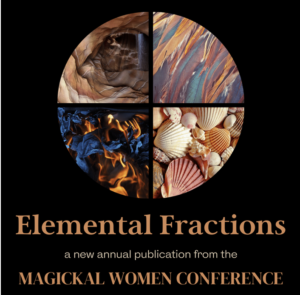
“The Magickal Women Conference is creating a series of four anthologies featuring stories connected to the elements of Earth, Air, Fire, and Water, be they found in the world around us, or forged from the elements themselves. These fractions of creativity aim to encourage and inspire magical thinking about the world around us.

“In the first of this series, we invite people to explore the element of Earth. Whether you write magical realism, folk horror, fantasy, or science fiction, we would love to read your submissions. What stories can be heard whispered between standing stones, what tales are undulating beneath our feet? We seek mycelial maps and crystalline realms, the stories that can be found in the hedgerows, ripe for the picking, and the magic that can be made with them. We invite you to contribute your fraction of Earth.”

Guidelines for submission are here. Submissions close June 30, 2023, or until the anthology is full, whichever comes first.

A circle divided into quarters, each of which has a symbol representing one of the four elements of earth, air, fire, and water. The words "Elemental Fractions, a new publication from the Magickal Women Conference" appear below.

Recent Posts:


Categories:


Archives:


My Pinterest
Follow Me on Instagram
Subscribe to RSS
Text-to-Speech Options