
Oracular Arts and Crafts: Making Clay Runes, Part 1

October 25, 2015 | Filed Under Tarot, Runes, Oracles | Comments Off on Oracular Arts and Crafts: Making Clay Runes, Part 1

Who doesn’t love a good crafts project? I’m no longer much for things requiring pipe cleaners and a half-pint milk carton, but I do enjoy playing while ostensibly making a thing of beauty and/or utility.

I have two sets of Elder Futhark runes (a gorgeous amethyst set from Wren, the talented maker at Wren’s Runes – I also have her amazing Lymirian Oracle, but that’s for another day; and, of course, the set that came with Ralph Blum’s book, because who didn’t have them at some point?).

I have a devastatingly beautiful and intensely magical set of hand-carved Futhorc Runes which were a gift.

So, what I really need is a rune set that includes the Elder Futhark, the Younger Futhorc, and some random medieval German and Dutch runes, which, according to Nigel Pennick, were probably used only for magical purposes, and not for divination. However, I really like the shapes, so I decided to make a set of all 41 runes.

So, here we go!
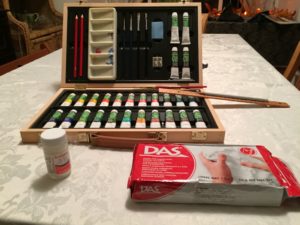
All the Supplies

All the Supplies

My original plan was to use Sculpey, but my local craft store had Prang Das Clay in stock, so I picked up a two pound block. As it turns out, two pounds was far more than I needed-the 41 runes took about a half pound of clay. Das clay is an air dry clay, whereas Sculpey is a heat drying clay. Das is also a more fibrous clay, so it has a more organic feel.

Take the usual crafting precautions–make sure you have all of your supplies, clear your workspace, wear clothes that can get messy, etc.  I used a regular non-stick rolling pin and a dough cutter, just like baking cookies. I did all of this on my kitchen counter, no special equipment or set up.

The first step is to roll out the clay so you can cut the runes from it. Just like baking, you cut a block of clay, work it with your hands and shape it into a ball, then roll it flat. I made my runes about 1/4″ thick, as the clay shrinks just a bit when drying. I want the runes to be solid and easy to handle without breaking.
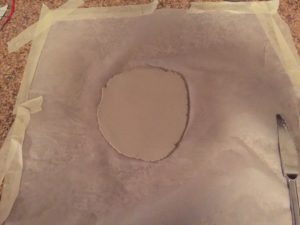
Rolled Clay

Rolled Clay

Keep the rest of the clay soft while you are working by covering it with a damp towel. This is air-drying clay, and wow, does it dry.
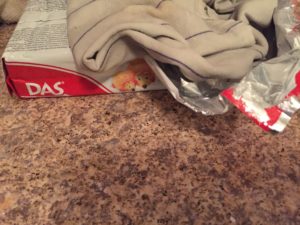
Keep the clay wet

Keep the clay wet

Once you’ve rolled the clay, cut off the top edge of the circle to create a straight line.
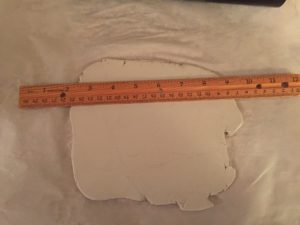
Marking the top line

Marking the top line

I used toothpicks to draw light lines across the clay. I use a ruler to make it easier—I am not one of those people who can just look at something and cut it perfectly.
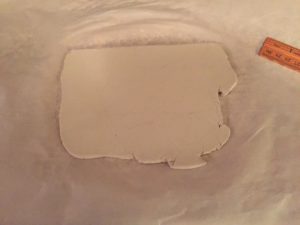
Straight Across the Top

Straight Across the Top

Next, cut one row from the clay to make the runes. I made my runes 1.5″ tall and 1″ wide–easy to measure, and a good visual and tactile proportion.
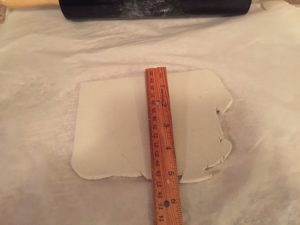
Measure Twice

Measure Twice

Cut one horizontal row. Did I manage to get a picture of that? Well, no. But you know what the word “horizontal” means, so I have faith in your ability to imagine what it looks like.

Put the rest of the rolled out clay on the wet cloth that’s covering the main block of clay. Put it face down onto the cloth, as that’s the edge you’ll be cutting and drawing on, so you want it to stay flexible.
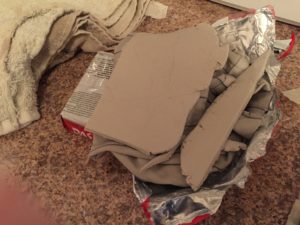
Face-down on the towel

Face-down on the towel

Mark the strip of clay with the toothpick so you can make neat vertical cuts to create the individual runes:
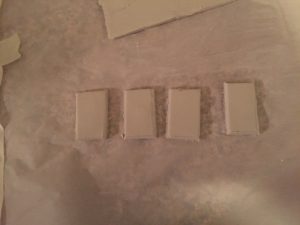
Cut vertically

Cut vertically

The edges will be rough from the cuts.
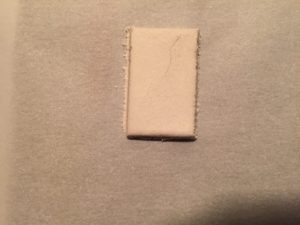
Rough Edges

Rough Edges

Dip your finger in water, and smooth the edges.
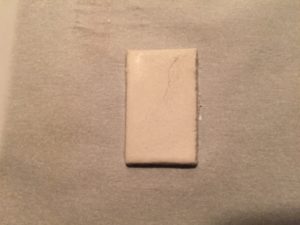
Smooth Edges

Smooth Edges

I will be painting my runes once they’re dry, but since my freehand drawing skills are about as good as my freehand cutting skills, I used toothpicks to carve each shape into the tiles. A few times, the hand did not do what the brain intended, so that particular tile went back into the clay pile. However, that’s much easier than to fix a bad paint job once the tile has dried.

Dipping the carving end of the toothpick in water helped make cleaner lines. Because the clay has a fair amount of pulp in it, it pills as you trace in it. I was able to ease most of it off the surface, but a bit of sanding will be in order once they have dried. The instructions say it can be sanded with a basic emery board, so I won’t have to go all the way across the back yard to the garage to get the sandpaper.

So, now I have 41 tiles of wet clay, carved with runes:
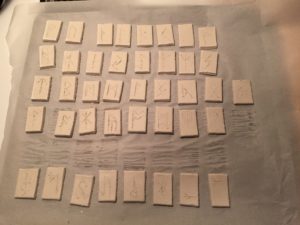
Waiting to dry

Waiting to dry

The whole process, including clean up, took just under two hours, and there’s not a trace of clay or disarray in my kitchen.

The instructions say that the clay will be fully dry in 24 hours. We’ll find out! Then it will be time to paint them. Stay tuned!

Bindrune for Confidence

October 21, 2015 | Filed Under Bindrunes, Tarot, Runes, Oracles | Comments Off on Bindrune for Confidence

If you are new to working with bindrunes, I suggest you read the introductory bindrune post here, then return to this post to read about this specific bindrune.

As the Wheel of the Year turns, many of us are looking at significant changes in our lives, sometimes multiple changes happening all at once. This bindrune is designed to help you focus your energies and face those changes with confidence.

Bind Rune for Confidence - Uruz, Ac, Teiwaz

Bind Rune for Confidence – Uruz, Ac, Teiwaz

Uruz (brown): As the base of the bindrune, Uruz provides strength and energy for movement. Once we have decided on an action, we must do something to start that action. Uruz gives the boost needed to begin our work, and to keep us in motion once we have started. This is the earthy, and yet wild, strength of the aurochs, and while it is a great resource, we need to combine it with other runes to channel its energy in constructive ways.

Ac (red): Strength in flexibility and persistence. We need the action energy of Uruz to start, and the adaptable strength in Ac to keep going. As we move forward with our plan, we encounter unexpected plot twists, both positive and negative, that require us to change our methods and timeline. Ac helps us make the best use of the positive developments, and to work around the apparent obstacles and delays. Raven Kaldera likens Uruz to the irresistible force, and Ac to the immovable object. We need both kinds of strength to build and maintain our confidence.

Teiwaz (green): We are more confident when we believe we are doing the right thing, and for the right reasons. Engaging in deceitful actions, telling lies, and manipulating people is one approach to getting what we want, but we don’t feel good about ourselves or our actions, and that undermines our confidence. Thus, we incorporate Teiwaz, bringing in Tyr’s energy of honor and duty to keep us focused on right action as we make our plans and move forward. Setting our intentions for the highest good of all is a direct way to remind ourselves that we are acting to make changes that are of shared benefit, not for our benefit at the expense of others’ well-being. Teiwaz helps to channel the wild energy of Uruz, and reminds us that true confidence comes from right action.

The bindrune on the left was done in colored pencil. The one on the right was done with calligraphic marker. They are the same bindrune, shown in two different media to give an idea of how the same bindrune looks different depending on how it is created.

You could also put a drop of sage oil on the rune for a bit of aromatherapy reinforcement.

Wishing you a successful week!

Bindrune for Calm

October 13, 2015 | Filed Under Bindrunes | Comments Off on Bindrune for Calm

If you are new to working with bindrunes, I suggest you read the introductory bindrune post here, then return to this post to read about this specific bindrune.

Everyone I know is going through some kind of major change right now–work, home, relationships, family–something. With so much intense emotional energy running through the air, this seems like a good week to create a bindrune for channeling that energy to help us stay calm and focused enough to deal with things.

Bind Rune for Calm: Eihwaz, Isa, Laguz

Bind Rune for Calm: Eihwaz, Isa, Laguz

Eihwaz (purple): facilitates energy movement to keep energy flowing within channels.

Isa (light blue): acts as a boundary to contain the energy within Eihwaz.

Laguz (dark blue): allows energy to flow freely, so there is no build up of stuck energy to create anxiety or depression.

The bindrune on the left was done in colored pencil. The one on the right was done with calligraphic marker. They are the same bindrune, shown in two different media to give an idea of how the same bindrune looks different depending on how it is created.

You could also put a drop of lavender or bergamot oil on the bindrune, as those scents have a calming effect on the human nervous system.

Wishing you a calm and pleasant week!

Review: Pagan Magic of the Northern Tradition, Nigel Pennick

October 12, 2015 | Filed Under Reviews | Comments Off on Review: Pagan Magic of the Northern Tradition, Nigel Pennick

Destiny Books has my  number. They have released several titles relating to Northern Traditions this year, and kindly sent me a copy of Pagan Magic of the Northern Tradition: Customs, Rites, and Ceremonies, the latest from Nigel Pennick.

Pagan Magic of the Northern Tradition by Nigel Pennick

Pagan Magic of the Northern Tradition by Nigel Pennick


If you are not familiar with Pennick’s work, this is a very good place to start. Pennick is a serious scholar, and his work is peppered with notes and cross-references. The book contains a 15 page glossary and a 30 page bibiliography. Be still, my beating academic heart!

Pennick is also an entertaining writer, so the book, while densely packed with information, is pleasurable to read. The research is extensive,  the anecdotes are relevant, and the breadth of topics covered is delightful.

The book opens with an introduction to Northern Magic to acquaint the reader with basic concepts and terms, and sets an engaging tone for the text. Subsequent chapters cover a myriad of facets of daily life–measuring time, measuring distance, crafting, building construction, social justice, funeral customs, music, and countless quotidian details which add richness to our understanding of how people lived. Who knew that a simple pothook was also a powerful magical object? I didn’t, but now I do.

A plethora of photos, drawings, and diagrams are quite helpful for understanding some of the less-familiar concepts and narrative in the book, especially in the chapters dealing with measurement of distance and building.

Pennick explores how our ancestors used practical magic on a daily basis to manage their lives. Much was beyond their control, and much is still beyond our control, despite our scientific advances and technical inventions. Pennick draws a direct connection between us and our forebears:

“We are within our given circumstances, living in our own lives, and must endure their accompanying difficulties, but how we endure them and how we deal with our circumstances is up to us.” (Page 15)

Each chapter is a balanced combination of history, theory, anecdote, and philosophy. The definition of “Northern” is generous, and covers the expected Nordic, Scandinavian, and Germanic areas, and also branching out east and south to the Baltic and Slavonic territories, and west to the British Isles.

Pennick provides plenty of examples of invocations, chants, and common practices to give a full picture of our ancestors’ daily lives. Whether they were creating wooden charms to keep the horses safe in the stable, or building houses in alignment with earth energies and divine geometry, our forebears were using the tools and knowledge available to them create a human space in a wild world. They kept an amazingly accurate calendar of events to honor their Gods and the Wheel of the Year, and their adherence to these traditions to keep them grounded in a hard world gives us a strong example to follow in our own different, but not entirely dissimilar, world.

Where our ancestors used chants, sigils, and specific rituals, we have our own magic of wireless signals and social rituals. In their efforts to create a safe space for a happy home, to reckon time, and to honor life, we see our own efforts–the same intent, but rather different in form–as we practice them today. Pennick’s message of the need for “Keeping Up the Day” come through clearly, and his book is packed with ideas we can adapt to continue our ancestors’ traditions in ways that make sense for us and our world.

Bindrune for Prosperity

October 6, 2015 | Filed Under Bindrunes | Comments Off on Bindrune for Prosperity

If you are new to working with bindrunes, I suggest you read the introductory bindrune post here, then return to this post to read about this specific bindrune.

Our first bindrune will be one to attract prosperity. Even though some industries are running hot and the companies in those fields are doing well, the rising tide has not raised all boats. This bindrune can help focus your energies to attract and maintain financial security.

Bindrune for Prosperity

Bindrune for Prosperity

The runes in this bindrune are:

Fehu (blue): A sign of wealth, possessions, tangible property. Whatever you have at present–even if it’s just one dollar–is a start. What you have will attract more of the same.

Othala (brown): This is seen as inherited wealth, that which we receive from our forebears. Even if you aren’t heir to a monetary fortune, you have inherited much from  your ancestors–your body, your world view, your very being and core self, from which you draw to create your life. Your hamingja, all that is truly yours by way of inheritance.

Berkana (green): The rune of the birch tree brings growth to what you already have. Berkana can also represent new opportunities for creating wealth, and new possibilities for improvement of a situation that feels stuck or hopeless.

You can add a drop of essential oil to strengthen the magic—cinnamon is good for prosperity work. You could also use a hoodoo oil, such as Money Drawing, if you work with those oils.

Recent Posts:


Categories:


Archives:


My Pinterest
Follow Me on Instagram
Subscribe to RSS
Text-to-Speech Options