Oracular Arts and Crafts: Making Clay Runes, Part 4

November 1, 2015 | Filed Under Tarot, Runes, Oracles | Comments Off on Oracular Arts and Crafts: Making Clay Runes, Part 4

You can read the exciting lead-up to this post in:

Oracular Arts and Crafts: Making Clay Runes, Part 1

Oracular Arts and Crafts: Making Clay Runes, Part 2

Oracular Arts and Crafts: Making Clay Runes, Part 3

The runes have cured, and been painted:
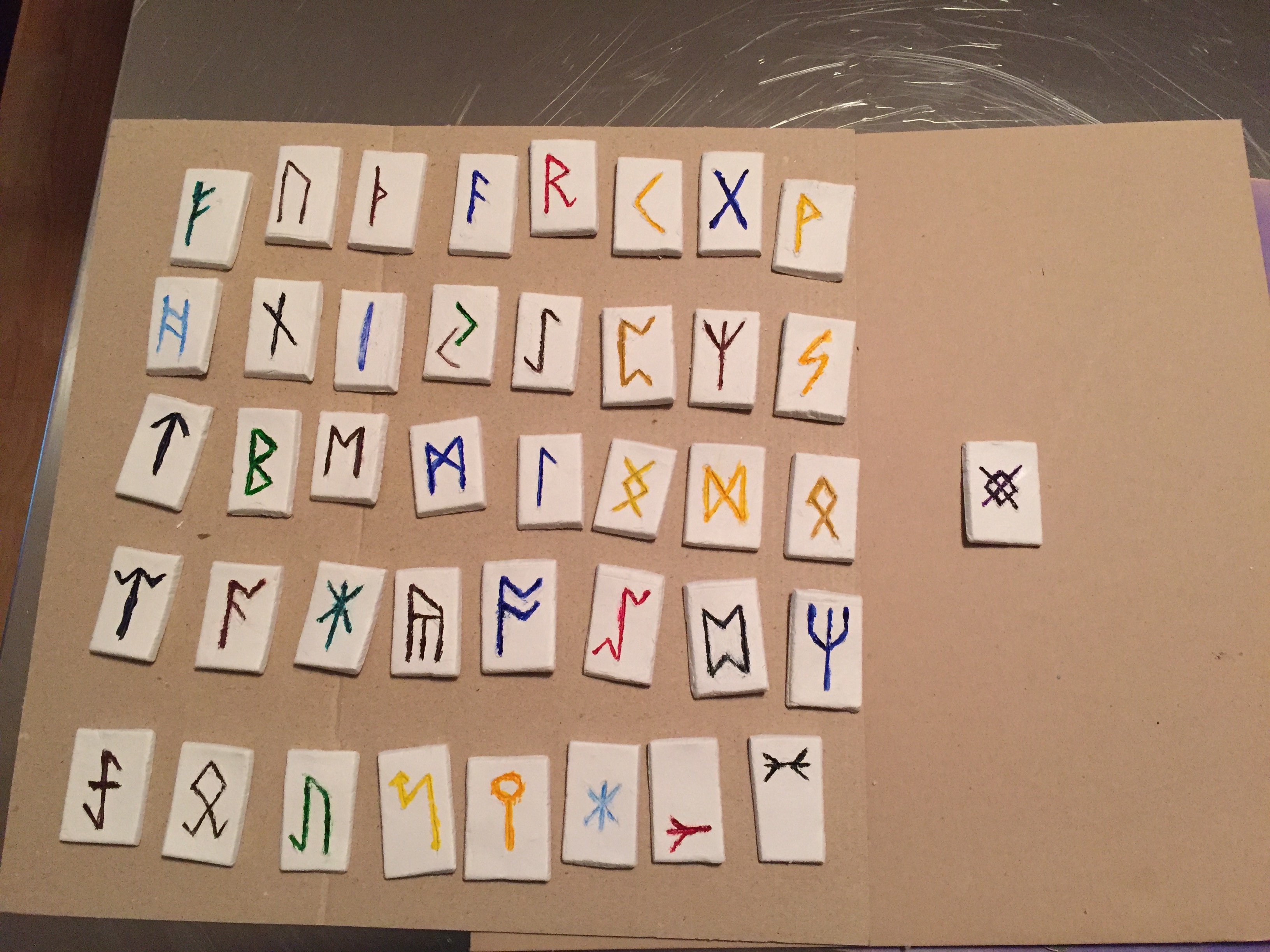
Runes - Wet Paint

Runes – Wet Paint

The unfinished clay is smooth enough to handle. However, since these are going to be handled a lot, I’ve chosen to seal them to protect the paint and help keep them from accumulating dirt, finger smudges, etc.

I used Sculpey Satin Glaze as the sealant. The jar promises that it needs only 30 minutes between coats, which was true. Doing the first round took just about a half hour, and by the time I finished the last rune, the first one was ready for another coat of sealant.

I did the four edges and the top of each tile. Edges first, and then the top, so the extra bits from the sides could blend into the top finish. I used a regular medium width artist’s brush to apply the glaze. A light touch is necessary, and even then, the glaze will try to pool in the cut designs, especially where lines cross. I used a smaller, stiff brush to go over the painted design to pick up the excess glaze. The glaze is clear, so it did not dramatically change the colors of the paint.
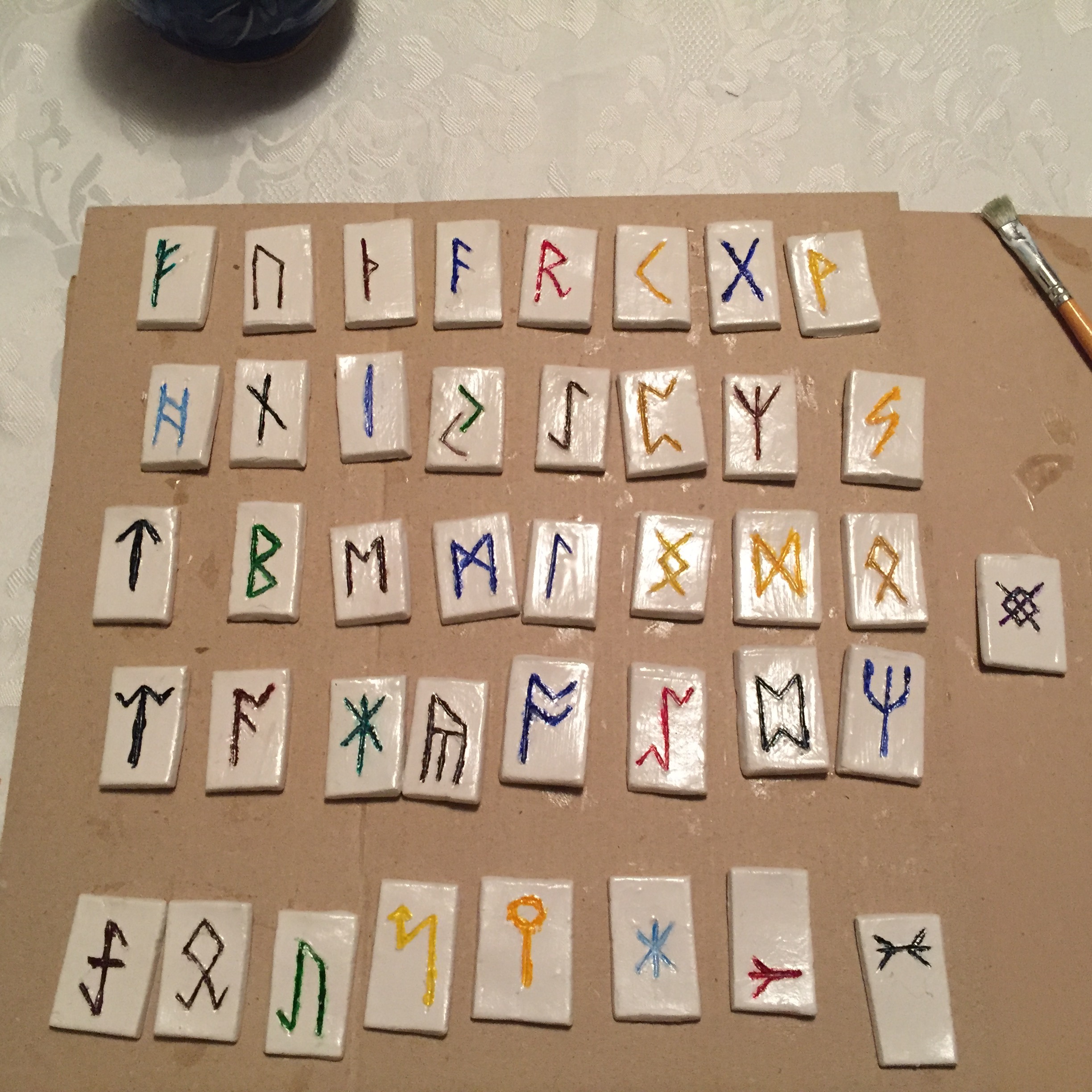
Glazed Runes - Still Wet

Glazed Runes – Still Wet

The finish is satin, in that it’s a bit shiny, but not particularly glossy. The glaze is still wet in the above photo, but the shine is less noticeable once the glaze dries.

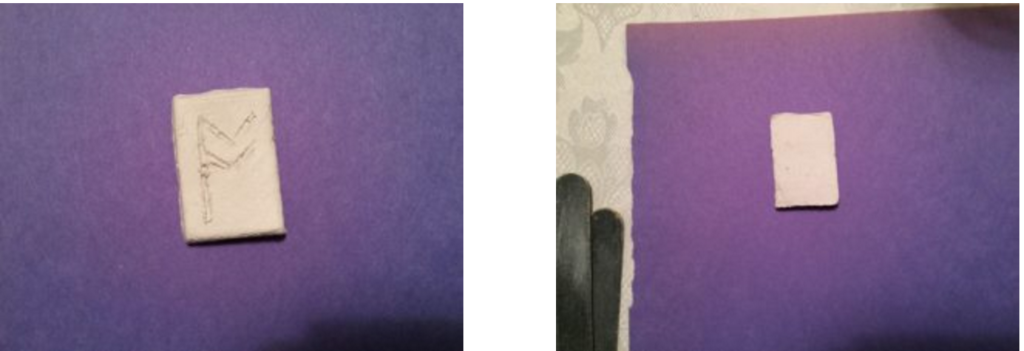
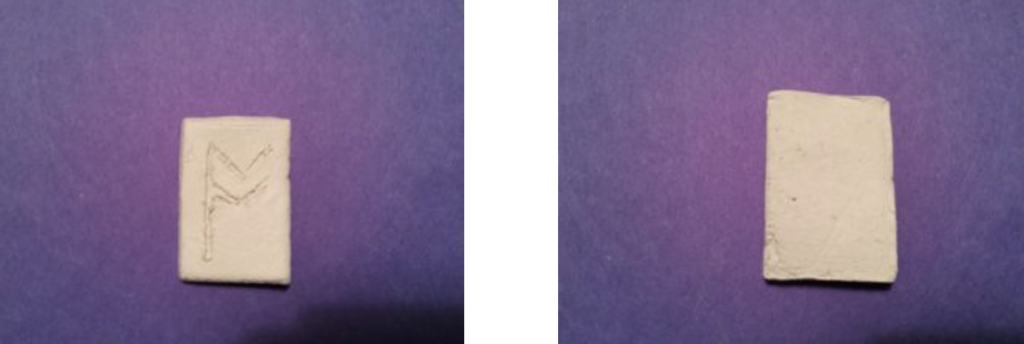
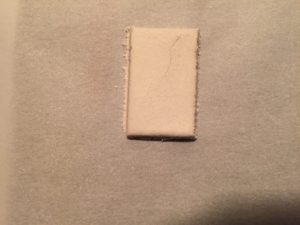
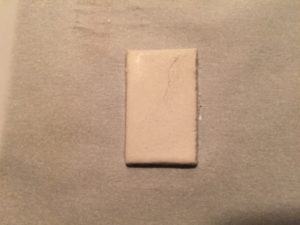
The tile with Freuydal has two fully dry coats of glaze. The blank tile next to it is the unglazed back of the Wan tile.
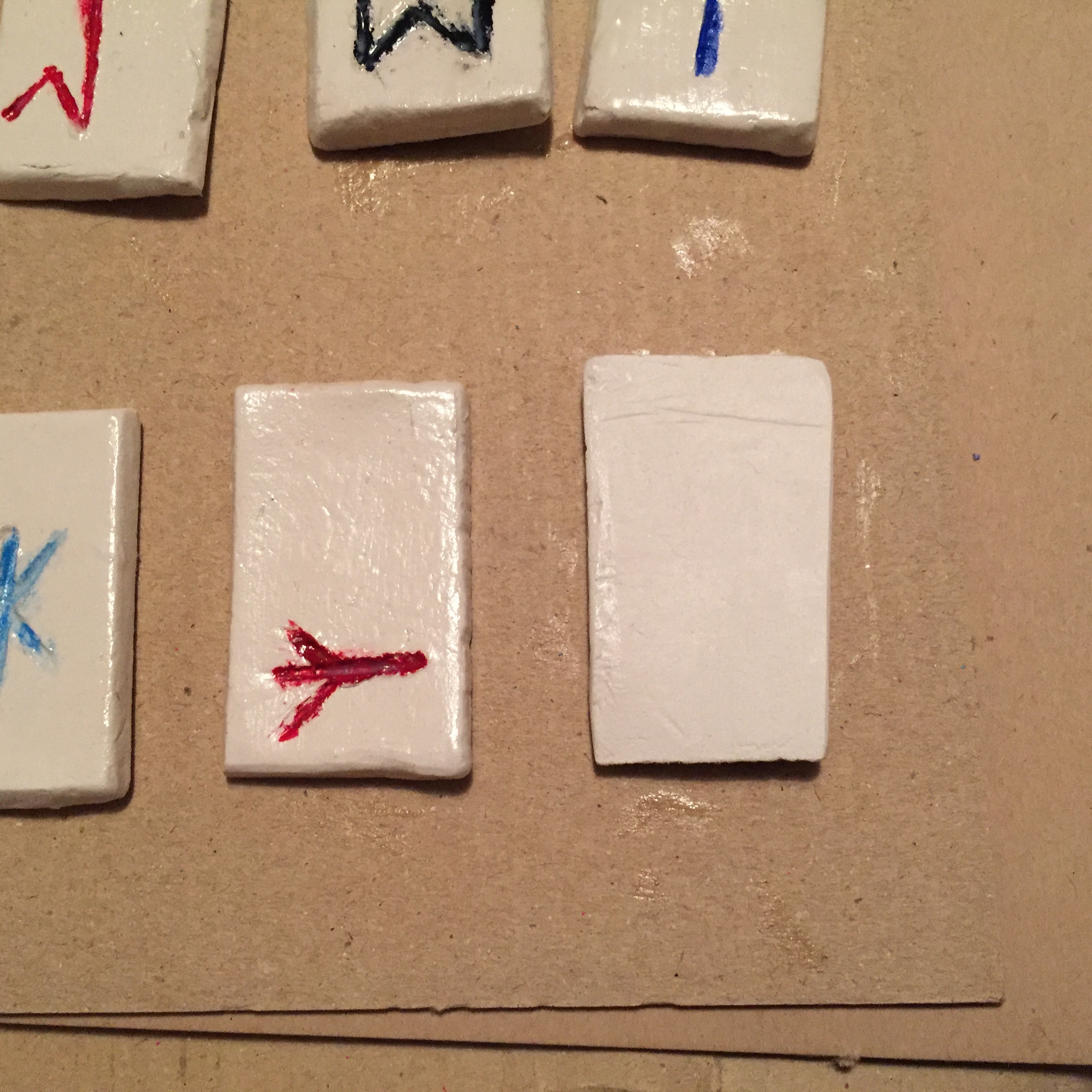
Glazed vs Unglazed Clay

Glazed vs Unglazed Clay

The glaze does give a noticeable sheen to the clay, but it’s not a high gloss. You can, of course, use a semi-gloss or high-gloss glaze, if that is your desired effect.  I am going to try a high-gloss glaze on one of the future sets.

Total time to apply two coats of glaze, front and sides: 1 hour. Total working time to date: 5.5 hours.

These are going to sit for 24 hours to fully dry, then the only thing left to do before they can be used is to glaze the backs and let those dry.

If all goes as planned, I can start reading with these on Tuesday night!
Oracular Arts and Crafts: Making Clay Runes, Part 3

October 31, 2015 | Filed Under Tarot, Runes, Oracles | Comments Off on Oracular Arts and Crafts: Making Clay Runes, Part 3

For those just tuning in, the earlier adventures are recounted in these posts:

Oracular Arts and Crafts: Making Clay Runes, Part 1

Oracular Arts and Crafts: Making Clay Runes, Part 2

This past week didn’t go quite as planned, so the painting step, scheduled for Wednesday night, was pushed off to tonight. However, spending Samhain Night painting runes was wonderfully magical!

Runes - Wet Paint

Runes – Wet Paint

I used Reeves Acrylic paints. Prang recommends an acrylic watercolor for painting Das clay. I like the Reeves colors because they are easy to work with, and the colors are clear and sharp. I wanted to avoid diluting the colors, since the Das clay goes soft when wet, so being able to use the paint straight out of the tubes was ideal. Reeves also makes acrylic watercolor paint, which is different from the regular acrylic paints I used, but again, since the clay reacts to water, adding water back via the paint seemed like it would produce undesirable results.

I was quite glad I had smoothed the edges of the rune shapes, as the few places where I had not done so with full care, the paint bled into the ridges. This was easily addressed with the end of a toothpick dipped in water, as that provided just enough moisture to soften the ridge so I could remove it. There were also a few times where my fine motor skills were insufficiently fine, and I managed to get paint on a part of the tile that wasn’t supposed to be painted. Not to fear, though–my friend, the dampened toothpick, solved that problem as well. I will have to re-buff those tiles once the paint is dry, but it was helpful to be able to erase the misplaced paint.

I chose the colors based on personal preference. Cweorth and Wendhorn, being fire-related, are red. Berkana is a rune of growth, so a vibrant spring green felt like the right choice. Isa is an icy blue. The upper symbol on Jera is green, the lower one is brown, reflecting the cycle of seasons. And so on, as I felt moved to match color to symbol.

Next time around, I will see about finding brushes with even finer tips (if possible–these were pretty narrow), start with new brushes (these have been working with me for a while), and have a few more to hand.

Total painting time: 1.5 hours. Total working project time to date: 4.5 hours.

The paint needs just a few hours to dry, so the runes will sit overnight while I make a little more Samhain magic, and then sleep.

The next step is to re-buff the few that need it, touch up the paint (if required), and then seal them. That’s on the schedule for Monday–check back on Tuesday to see how it goes!


Bindrune to Create a Glamour

October 28, 2015 | Filed Under Bindrunes, Tarot, Runes, Oracles | Comments Off on Bindrune to Create a Glamour

If you are new to working with bindrunes, I suggest you read the introductory bindrune post here, then return to this post to read about this specific bindrune.

Life can present us with occasions for which we feel inadequate, or perhaps we just need a boost to help us present our best aspect. To go with last week’s bindrune for confidence, this week’s rune helps to create a glamour to help us appear as we wish to be seen. “Act as if” can be a helpful technique–for example, act as if you are calm and confident, and the casting director at the audition (or potential date at the cafe, or hiring manager at the job interview) is more likely to see you that way.

Now, you could use this bindrune to cast a glamour in a negative way–for example, to convince someone to trust you when you are actually using them for our own purposes–but I wouldn’t recommend that. It’s between you, your conscience, and your Gods, of course. But, my advice is–don’t.

Bind Rune for a Glamour - Ior, Dagaz, Laguz

Bind Rune for a Glamour – Ior, Dagaz, Laguz

Ior (green): The rune of Jormundgand draws in the Great Serpent’s boundary magic. We clearly define our boundaries, and thus ourselves, as we wish to be seen. This rune also calls upon Jormundgand’s fluid identity as perceived by others. While the Great Serpent is a unique being without gender, many who work with Jormundgand see him/her/hir as their own gender, and thus Jormundgand becomes the screen for our projections the way we wish to become the screen for the other person’s positive projections.

Dagaz (orange): This rune brings in the light of day, the brightness needed to dazzle our audience. Dagaz also functions as an energy filter, allowing out only what we wish to put forward for others to see. The converse of that, of course, is that it also filters what comes through to us, so the caution is to dazzle with, but not to be dazzled by, your own glamour.

Laguz (blue): With its flowing energy, Laguz can be quite useful in deflecting attention away from what we do not want others to see. We want to appear confident, so we don’t want them to see our nervousness. That’s good. We want to appear trustworthy, so we don’t want them to see our treachery. That’s not good. Just don’t do it. This rune has a a great deal of power to shape others’ perceptions of us–use it wisely.

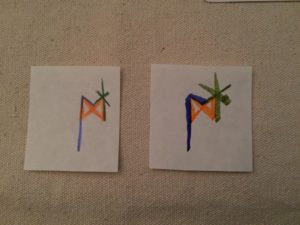
The bindrune on the left was done in colored pencil. The one on the right was done with calligraphic marker. They are the same bind rune, shown in two different media to give an idea of how the same bindrune looks different depending on how it is created.

You could also put a drop of rose oil on the bindrune, as the scent creates a sense of well-being, which boosts our energy and inspires others to open up to us.

Wishing you a glamourous week!

Oracular Arts and Crafts: Making Clay Runes, Part 2

October 26, 2015 | Filed Under Tarot, Runes, Oracles | Comments Off on Oracular Arts and Crafts: Making Clay Runes, Part 2

The first part of this creative adventure, in which I play with clay and manage not to destroy my kitchen, can be read here.

I’ve managed to leave the runes alone for 24 hours to dry. I turned them over after 16 hours, as the fronts were dry to the touch, but the backs were still visibly damp  (the color difference between wet clay and dry clay is noticeable—the wet clay is somewhat grayish, and the dry clay is more white).

After 24 Hours of Drying Time

After 24 Hours of Drying Time

So now, they look like this:

Dry on the front

Dry on the front

The edges are ragged, although not rough to the touch. Still, I want these to be pleasing to handle, so with my trusty emery board nail file (yes, the cardboard kind you buy in a package at the drugstore or the beauty supply store), I softened the edges and corners, and removed extraneous lumps.

Before:

Before—Front and Back

Before—Front and Back


A minute with the emery board, and we have:

After—Front and Back

After—Front and Back

Since some of the runes were not fully dry, they were soft in the center. This worked well in a few cases where I wasn’t entirely pleased with the shape of the rune incision, so I took advantage of the moment to make the shapes more exact. For the others, though, this required careful handling not to bend the rune out of shape. I probably should have left well enough alone for another 24 hours to let them completely dry. On the other hand, a few really needed to be reshaped, so I’m just as glad to have done this all tonight.

Tonight’s smoothing and polishing took just under an hour, bringing the total project time so far to three hours.

The next step is to paint the symbols. In theory, I will have time on Wednesday evening, so check back on Thursday for the next update!

Oracular Arts and Crafts: Making Clay Runes, Part 1

October 25, 2015 | Filed Under Tarot, Runes, Oracles | Comments Off on Oracular Arts and Crafts: Making Clay Runes, Part 1

Who doesn’t love a good crafts project? I’m no longer much for things requiring pipe cleaners and a half-pint milk carton, but I do enjoy playing while ostensibly making a thing of beauty and/or utility.

I have two sets of Elder Futhark runes (a gorgeous amethyst set from Wren, the talented maker at Wren’s Runes – I also have her amazing Lymirian Oracle, but that’s for another day; and, of course, the set that came with Ralph Blum’s book, because who didn’t have them at some point?).

I have a devastatingly beautiful and intensely magical set of hand-carved Futhorc Runes from Raven Kaldera and the good folk of Cauldron Farm.

So, what I really need is a rune set that includes the Elder Futhark, the Younger Futhorc, and some random medieval German and Dutch runes, which, according to Nigel Pennick, were probably used only for magical purposes, and not for divination. However, I really like the shapes, so I decided to make a set of all 41 runes.

So, here we go!

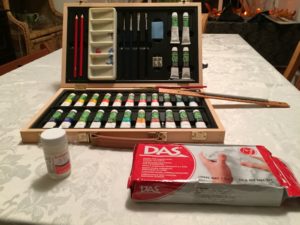
All the Supplies

All the Supplies

My original plan was to use Sculpey, but my local craft store had Prang Das Clay in stock, so I picked up a two pound block. As it turns out, two pounds was far more than I needed-the 41 runes took about a half pound of clay. Das clay is an air dray clay, whereas Sculpey is a heat drying clay. Das is also a more fibrous clay, so it has a more organic feel.

Take the usual crafting precautions–make sure you have all of your supplies, clear your workspace, wear clothes that can get messy, etc.  I used a regular non-stick rolling pin and a dough cutter, just like baking cookies. I did all of this on my kitchen counter, no special equipment or set up.

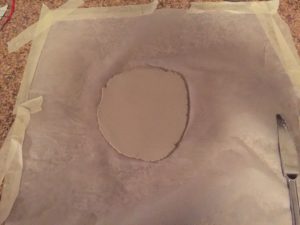
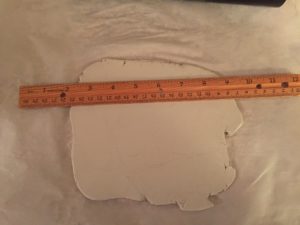
The first step is to roll out the clay so you can cut the runes from it. Just like baking, you cut a block of clay, work it with our hands and shape it into a ball, then roll it flat. I made my runes about 1/4″ thick, as the clay shrinks just a bit when drying. I want the runes to be solid and easy to handle without breaking.

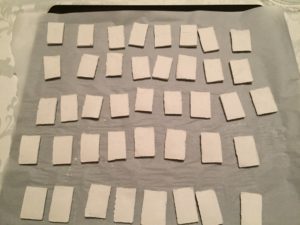
Rolled Clay

Rolled Clay

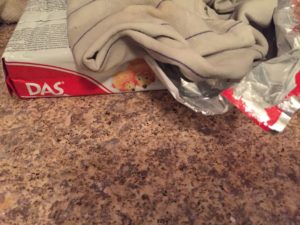
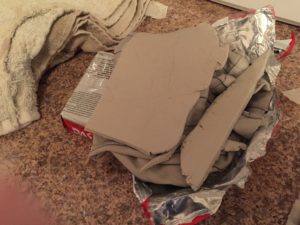
Keep the rest of the clay soft while you are working by covering it with a damp towel. This is air-drying clay, and wow, does it dry.

Keep the clay wet

Keep the clay wet

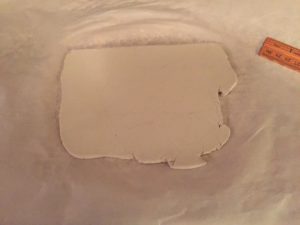
Once you’ve rolled the clay, cut off the top edge of the circle to create a straight line.

Marking the top line

Marking the top line

I used toothpicks to draw light lines across the clay. I use a ruler to make it easier—I am not one of those people who can just look at something and cut it perfectly.

Straight Across the Top

Straight Across the Top

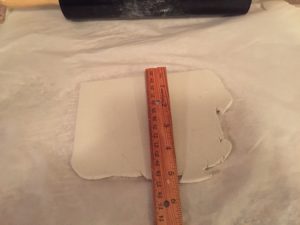
Next, cut one row from the clay to make the runes. I made my runes 1.5″ tall and 1″ wide–easy to measure, and a good visual and tactile proportion.

Measure Twice

Measure Twice

Cut one horizontal row. Did I manage to get a picture of that? Well, no. But you know what the word “horizontal” means, so I have faith in your ability to imagine what it looks like.

Put the rest of the rolled out clay on the wet cloth that’s covering the main block of clay. Put it face down onto the cloth, as that’s the edge you’ll be cutting and drawing on, so you want it to stay flexible.

Face-down on the towel

Face-down on the towel

Mark the strip of clay with the toothpick so you can make neat vertical cuts to create the individual runes:

Cut vertically

Cut vertically

The edges will be rough from the cuts.

Rough Edges

Rough Edges

Dip your finger in water, and smooth the edges.

Smooth Edges

Smooth Edges

I will be painting my runes once they’re dry, but since my freehand drawing skills are about as good as my freehand cutting skills, I used toothpicks to carve each shape into the tiles. A few times, the hand did not do what the brain intended, so that particular tile went back into the clay pile. However, that’s much easier than to fix a bad paint job once the tile has dried.

Dipping the carving end of the toothpick in water helped make cleaner lines. Because the clay has a fair amount of pulp in it, it pills as you trace in it. I was able to ease most of it off the surface, but a bit of sanding will be in order once they have dried. The instructions say it can be sanded with a basic emery board, so I won’t have to go all the way across the back yard to the garage to get the sandpaper.

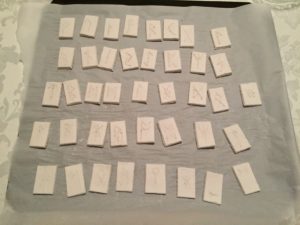
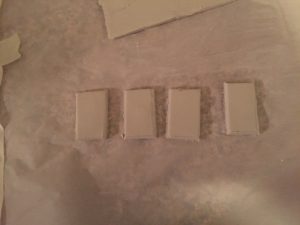
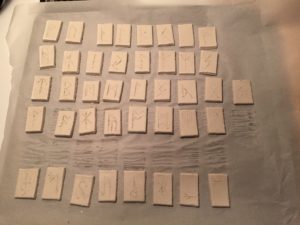
So, now I have 41 tiles of wet clay, carved with runes:

Waiting to dry

Waiting to dry

The whole process, including clean up, took just under two hours, and there’s not a trace of clay or disarray in my kitchen.

The instructions say that the clay will be fully dry in 24 hours. We’ll find out! Then it will be time to paint them. Stay tuned!

Recent Posts:


Categories:


Archives:


My Pinterest
Follow Me on Instagram
Subscribe to RSS
Text-to-Speech Options