Doing some research on Rachel Pollack, I found this article, “Don’t Call Me Mister You Fucking Beast”, a piece written by the Transvestite, Transsexual and Drag Queen group of the GLF at some point in 1972. It was transcribed to hypertext from Come Together – The Years of Liberation 1970-1973 by Autumn. According to Morgan Page, the authors include Rachel Pollack and Roz Kaveney. The site notes: “No copyright claimed on any of the transcriptions uploaded here. Please enclose transcription credits and remarks where possible. This is a community effort. IP is bullshit.”
Before you get upset about the language in the article, remember this was written in 1972, with the vocabulary available at the time.
What leapt out at me:
“Certainly one thing becomes more and more clear as we come together; pass or not pass, we can’t let anybody tell us what we are. One sister said that after six months of psychiatric treatment she discovered that no one knew her like herself. We can’t let anybody tell us we’re men, when we know we’re women. As Holly Woodlawn once said in New York, ‘Don’t call me mister, you fucking beast!'”
I can hear Rachel reading these words out loud, proudly, calmly, and fiercely.
Thank you, Rachel, for inspiring people everywhere to be their authentic and best selves.
January 15, 2024 | Filed Under Things I Think About | Comments Off on Standing in a Garage
Going to church no more makes you a Christian than standing in a garage makes you a car.
~ Garrison Keillor
And going to bløts no more makes you Heathen than standing in a garage makes you a car.
Showing up is a start, but then what do you do with the experience afterward? Did you learn something to share? Did you learn something about yourself that you can work with to make a change? Were you moved to a new level of connection with your kindred, community, or deities that prompted you to make or renew a commitment?
Showing up, singing songs, and passing the horn is fun, but fun is not the only goal—you could go to the movies or play miniature golf if your only aim is fun.
We spend time in ritual, in study groups, in other community activities to learn from each other, to learn about ourselves, our gods, and other entities, and to learn about what being Heathen looks like on a daily basis in real time and real life. We find ways to manifest our values in our words and actions, so that what we say and do is congruent with our beliefs. We do better at being the people we aspire to be, and do better at inspiring others to be their best selves.
January 14, 2024 | Filed Under History | Comments Off on Pantographia: Containing Accurate Copies of All the Known Alphabets in the World
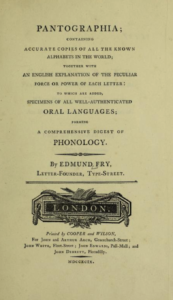
Our friends at the Public Domain Review have posted Edmund Fry’s Pantographia: Containing Accurate Copies of All the Known Alphabets in the World from 1799. It contains 405 alphabets from 164 languages. PDR notes that, “To get these letters into print, Fry carved each one onto a steel punch, which could be pressed into a copper matrix for printing. It took him sixteen years, four thousand punches, and an estimated ten thousand hours of labor.”
Some of the alphabets are the ones you would expect from an educated gentleman of the late 18th century—Latin (12 options), Greek (39 varieties!), and Phoenician. There are many surprises, however, including North American Indigenous languages fitted to the Roman alphabet (awkwardly, many times), six varieties of Arabic, and many languages noted as “a dialect of” some far-off land that we know today by another name, e.g. “The Sandwich Islands”, which we call Hawaii).
The book uses the Christian Lord’s Prayer as its example text for almost all of the languages, an understandable choice for the time of publication. It includes a few vocabulary words for some languages, which have a few common words (mother, father, house), but the differing words reveal more about the culture the language is from, and Fry’s perspective on that culture, than Fry probably intended.
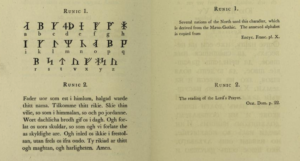
Pages 244-245 feature the “Runic” alphabet of Iceland:
If you have any interest in alphabets, languages, or historical books, I recommend checking out the uploaded book—it’s fascinating, and I enjoyed it greatly!