Ginnungagap: New from Jethro Tull
Exciting music news! Jethro Tull‘s new album “RökFlöte” is coming out in April 2023! They’ve released one track with video. Check it out!
[artwork with link to the preview song video]

Exciting music news! Jethro Tull‘s new album “RökFlöte” is coming out in April 2023! They’ve released one track with video. Check it out!
[artwork with link to the preview song video]
Our beloved Rachel Pollack has been recovering at home, and doing alright, until this week. This is the most recent update from her wife, Zoe:
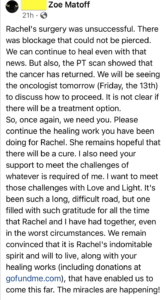
So, please light candles, speak to Whoever is listening, and, if you can, donate to the GoFundMe for Rachel’s medical care and the household’s living expenses.
The Seidhjallr Team of Hrafnar Kindred invites you to the Oracular Seidh on Sunday, November 27, 2022.
This is a ritual of Seeing for the People; all are welcome, heathen or otherwise, who come in good faith and in the spirit of frith.
Would you know more prior to attending? Check out “The Hrafnar Seidh Ritual” at
https://seidh.org/articles/seidh/
It will be a hybrid event:
*in person at the Berkeley Fellowship of Unitarian Universalists (BFUU) at 1924 Cedar Street.
*via Zoom for those unable to attend in person. Please contact me for the Zoom link.
Doors and the Zoom meeting will open at 5:00 PM PST for set up, and the pre-ritual information talk will begin at 5:15.
A donation of $5 is suggested, but no one will be turned away for lack of funds.
Bring your questions and our seeress will seek answers….
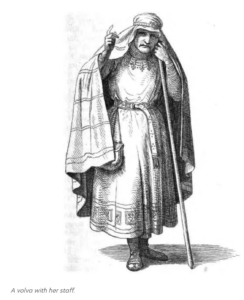
[Image description: A black-and-white line drawing of a woman in medieval Norse clothing. Her right hand is raised, with her index finger pointing up. Her left hand holds her staff.]
Thanks to this post at TimeAndDate.com, I learned today about the Equilux*!
Despite common belief, day and night are not equal on the Equinox. The Equinox is when the sun crosses the the celestial equator, so it rises due east and sets due west.

Day and night are equal lengths on the Equilux, which is either a few days before or after the Equinox.
The post above also has a link to help you find the Equilux in your location.
And now you have two days to celebrate!
*Not to be confused with Equilux Horse Cleaner Spray.

I spent more time than I realized on Friday night, watching the BBC livestream of Queen Elizabeth II’s lying-in-state.
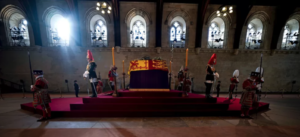
I´ve since spent more time watching on Saturday, and doubtless will revisit it until it ends on Monday morning (UK time).
The BBC provides a detailed explanation of the protocols:
https://www.bbc.com/news/uk-62878294
There are eight military guards standing watch: four Yeoman Warders, four House Guards, and two of the Horse Guards. There are also four constables standing guard.
Except for an occasional murmur, the stream is silent. The only real sound is beat of the footsteps for the changing of the military guard every 20 minutes, which is a nice bit of pageantry. I haven’t seen a change of the constables’ shift; they seem to do it informally. [UPDATE: I finally saw the constables’ shift change, and it’s as formal as that of the military. It’s staggered, time-wise, from the military change of shift, and the cameras don’t usually catch it.]
The Parliament Ushers are in their full dress outfits, and have done quite the job of keeping the crowds moving efficiently while also giving people time to express themselves.
Regardless of one’s feelings about Queen Elizabeth II, or monarchy, or the UK and its history, one cannot help but be moved by the reactions of the crowds as they stop at her coffin.
In the hours I’ve watched, I have not seen anyone behave inappropriately.
What I have seen:
People of all ages, economic classes, genders, ethnicities, countries, and faiths have come through. Many are dressed sensibly for standing in the cold, rain, and dark for 20 hours or more. Others are dressed formally under their down jackets and wool coats, and remove their overcoats to make a proper appearance upon entering.
People offering prayers in their own ways: spoken words, crossing themselves, making mudras, doing complex genuflections, a few even doing full prostrations; many simply holding up their hand, open-palmed.
People bringing their children. Even the toddlers, too young to understand what’s going on, know that it’s something important, and watch quietly. Others, sensing only that their parents are deeply emotional, follow their parents’ actions. One girl (probably around 10 years old) waited patiently, did a beautiful curtsey, straightened, then folded, weeping, into her mother as they walked away.
Current and former military personnel, some in uniform, some simply wearing their insignia on a plain coat, wearing a tam or a beret, saluting their Queen one final time, then doffing their caps and bowing.
Young people, who may or may not feel attached to the solemnity of the occasion, standing in line to accompany an older friend or relative for whom the Queen’s death is quite literally a life-changing experience.
An elderly couple, holding hands, even as they bowed.
A man in a feather headdress of the type worn by indigenous peoples in North America moved through the queue. He stopped, appeared thoughtful, and raised his arm in greeting? salute? blessing? before moving on.
People using mobility aids—canes, crutches, walkers, scooters, wheelchairs. The Parliament Ushers assist as needed. One man, dressed in a Union Jack suit, got up out of his wheelchair (with assistance) to make one last bow. I can’t imagine standing in line for 20 hours while on a cane or crutches, or sitting in a scooter or wheelchair for so long.
People quietly walking around a woman as she describes the coffin and catafalque to her blind daughter.
Many people bowing or curtseying. Some of them smooth and practiced; others stiff from the long time standing in line, or with age, or from simply not having done so since they learned it as small children, “in case the Queen comes to visit our school”.
The ones who don’t do a full bow/curtsey often incline their heads. I’ve seen very few people not do at least that much.
Many people end their time by saying, “Thank you”.
Many people blow kisses before they walk away. This is such a lovely thing to see.
Some people are dry-eyed. Some are openly weeping. Some at all stages in between, attempting with varying success not to cry publicly, and some allowing themselves to cry in public. The number of men who allowed themselves to shed tears publicly, for perhaps the first time ever, was moving.
Watching the honor guard, who are supposed to be standing, motionless and emotionless, with their weapons pointed down. They, too, are human, and are mourning. Seeing their shoulders shake, knowing they are trying so hard not to cry and not to move, is heartwrenching. A tear escaped the eye of one, which ran down his face unchecked, since the guards are not supposed to move while on duty.
The shared grief, the open emotions, the common bonds of people in mourning—we are all human, we all have feelings, we all need space and support in our mourning. Public rituals such as this help meet this need, individually and communally.
